A free script to read, record or print
A walking meditation script
Walking meditation is an ordinary walk with your attention on the walking: your feet, the air, what you hear and see. Below is a script of about 5 minutes that you can read before you go, record in your own voice, or print and take with you. If you would rather be guided, press play first.
Listen first, if you’d like a voice
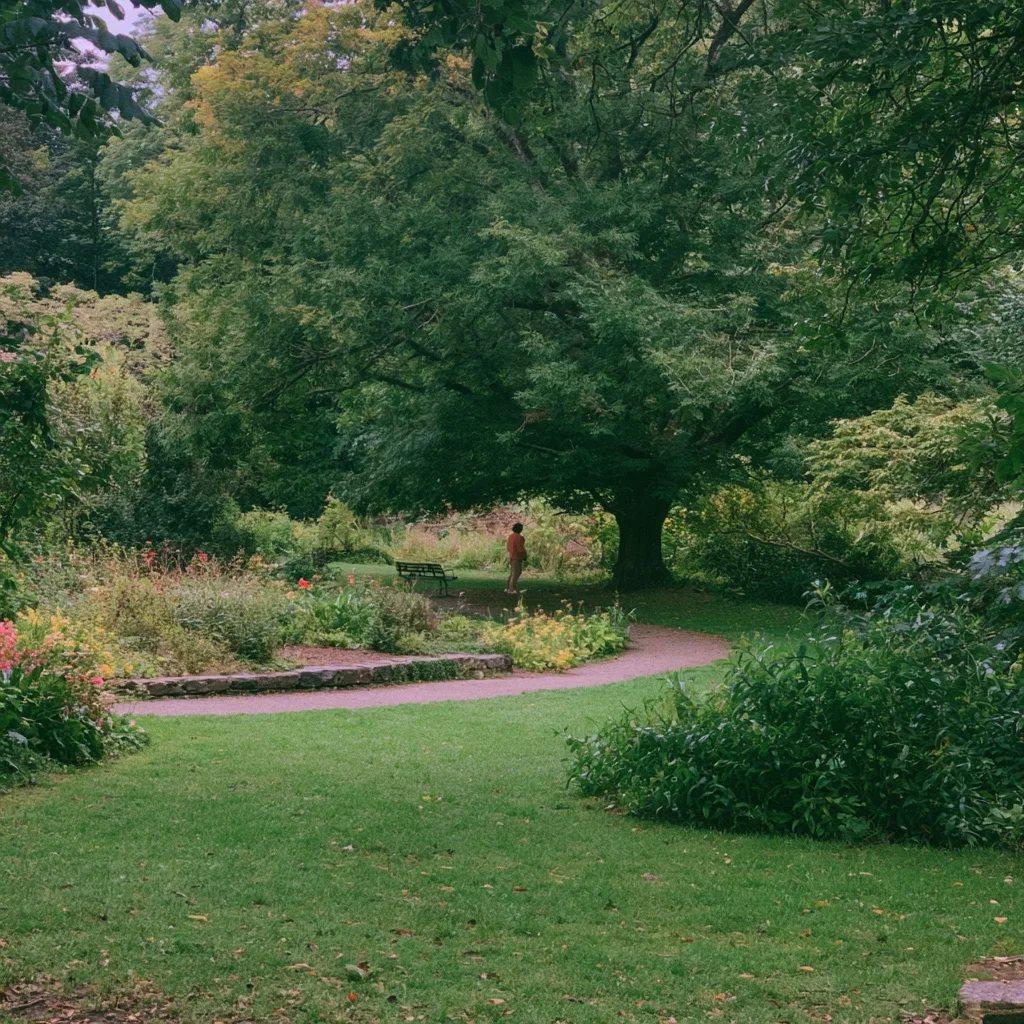
In the park
Find a spot in the park where you can stand or sit for a few minutes, a little away from the main path.
These recordings are short samples, under two minutes each. In the Rewyld app, you can take a guided walk for your place and today’s conditions.
Try a walk in the appRead the words of “In the park”
Find a spot in the park where you can stand or sit for a few minutes, a little away from the main path.
Let your feet, or the bench, take your weight. Breathe out slowly, and let your shoulders soften.
Look up first. What is above you right now? Branches, open sky, the edge of a roof?
Now look at the ground near your feet. What is growing there, or lying there, that you would usually walk past?
Listen. Which sounds belong to the park, and which come from beyond it?
Choose one tree or plant and move slowly towards it, if you can. Notice how it changes as you get closer.
Before you go, look back at where you started. Then carry on at whatever pace feels right.
Before you start
- Choose a stretch of path you can walk without checking directions: a loop of a park, the way to a shop, a quiet street. Ten steps back and forth on a patio is enough.
- Put your phone on silent, or press play on your own recording and keep it in your pocket.
- Walk with your eyes open. Wherever there are people or traffic, keep their pace and slow down only on the quieter parts.
If you use a wheelchair or walk with a stick or frame, the script works the same way. Where it says feet, follow the push of your hands, the turn of the wheels, or the feel of the handle.
A five-minute walking meditation
Read it slowly. The small notes in between are pauses: leave that much quiet if you record it, or simply walk for a while before you read on.
Arrive
Stand still for a moment at the start of your path. Let your feet take your weight, and let your arms hang loose.
Pause, about 10 seconds
Breathe out slowly. There is no need to change your breathing. Just notice the next breath arrive.
Pause, about 10 seconds
Feel where your feet meet the ground. Your heels, the balls of your feet, your toes.
Pause, about 10 seconds
Walk
Now start to walk, a little slower than usual. Feel one foot lift, move forward and land. Then the other.
Pause, about 25 seconds
If it helps, say three words to yourself as you go. Lifting. Moving. Placing.
Pause, about 15 seconds
Your mind will wander. When you notice it has gone somewhere else, that moment of noticing is the practice. Come back to the next step.
Pause, about 25 seconds
Widen
Let your attention open out to sound. What is the nearest sound you can hear? What is the farthest?
Pause, about 25 seconds
Now the air. Where do you feel it? On your hands, your face, the back of your neck?
Pause, about 20 seconds
Let your eyes rest a few steps ahead. Find one thing that is growing, or one patch of light, and watch it come closer as you walk.
Pause, about 25 seconds
If something catches you, stop and stay with it for as long as you like. Then walk on.
Pause, about 20 seconds
Return
Come back to your feet for the last few steps. Slow down a little more.
Pause, about 15 seconds
Now stop, and stand still. Feel the ground again. Look back along the way you came.
Pause, about 10 seconds
Take one more breath out here. Then carry on, at whatever pace your day needs.
That is the whole script: 13 lines, about 5 minutes with its pauses.
Print it or keep it on your phone
The same script on one page, with the pauses marked, to fold into a pocket or read from your phone outside.
Recording it in your own voice
Many people find a script easier to follow in a voice they know. Use your phone’s voice memo app, sit somewhere quiet, and read at the pace you would speak to someone walking beside you. Count the pauses in your head rather than rushing them. If a line does not sound like you, change it.
Then put the phone in your pocket, press play, and walk. You will know the words, which leaves your eyes free for the walk.
Variations for where you are
Keep the first and last parts of the script, Arrive and Return, and swap the middle for the lines below.
In a park
A park gives you room to slow right down. Keep the main script, and use these lines in the middle.
- Look up first. What is above you right now? Branches, open sky, the edge of a roof?
- Notice when the ground changes under your feet. Grass, gravel, a muddy patch, a root.
- Choose one tree and walk slowly towards it. Notice how it changes as you get closer.
- Before you turn back, put a hand on the bark if you can reach it.
Rewyld has a short recording for this one. Choose it in the player at the top of the page.
On a city street
On a busy street, keep your usual pace and let the street set the rhythm. The pauses come to you at crossings and doorways.
- Walk at the speed of the people around you. Feel each foot land on the pavement.
- At each crossing, while you wait, feel your weight in both feet and take one slow breath out.
- Look down for something growing where nobody planted it. A weed in a crack, moss on a wall, a tree in a pit.
- Listen past the traffic. Is there a bird, some wind, a sound from a doorway?
Rewyld has a short recording for this one. Choose it in the player at the top of the page.
In the cold
Cold is a good time for a shorter walk at a normal pace. Moving keeps you warm, and three minutes is plenty.
- Keep a steady pace, hands in your pockets if you like, and put your attention in your feet.
- Notice where the cold reaches you first. Your face, your ears, your fingers?
- If your breath shows in the air, watch one breath leave and fade.
- Listen to your footsteps. Do they sound different on frost, on snow, on dry ground?
In the rain
Rain gives you a great deal to listen to. Walk in a coat you trust, or stand under cover and let the rain do the moving.
- Slow your pace, or find a spot under cover. How does the air feel on your face?
- Look for somewhere the rain is landing. A leaf, a puddle, a wall. Stay with one small patch.
- Listen. Does the rain sound the same on everything it lands on? How many different sounds can you pick out?
- Notice where you feel the rain, if it reaches you. Or the damp in the air, if it does not.
Rewyld has a short recording for this one. Choose it in the player at the top of the page.
If you are new to walking meditation
How slowly should I walk?
Slower than usual, but not so slowly that you wobble or block a path. On a busy street, walk at the speed of the people around you. Some traditions walk very slowly, back and forth over a few steps; that is worth trying in a garden or a quiet corner.
What do I do when my mind wanders?
Notice that it has, and come back to the next step. It will happen many times in five minutes. Coming back is the practice, not a sign you are doing it wrong.
Eyes open or closed?
Open, always, when you are moving. Let your gaze rest a few steps ahead rather than on the ground at your feet.
Do I need to be in nature?
No. A street, the edge of a parking lot or a corridor all work. Outside tends to give your senses more to land on, which is why most of the lines point at air, sound and growing things.
Keep going
- How to take a mindful walkChoosing a route, what to notice, and a short guided walk.
- Things to notice on a walkHand-written prompts, grouped by sense, to take with you.
- Walking meditation with RewyldGuided walks composed for your place and the day’s conditions.
- How to take an awe walkWhat the 2020 awe walk study did, and how to try one.
- The sit spotReturn to one outdoor spot and notice what changes.