A practice with one study behind it
How to take an awe walk
An awe walk is a short walk where you go looking for something bigger than you, or something you have never noticed before. The idea comes from a study at the University of California, San Francisco, published in 2020, in which older adults took a 15-minute walk outdoors once a week for eight weeks.
Here is what the people in that study were asked to do, what changed for them and what did not, and how to take one yourself.
Start with your eyes up
This Rewyld recording opens by asking what is above you right now. Press play at the start of your walk.
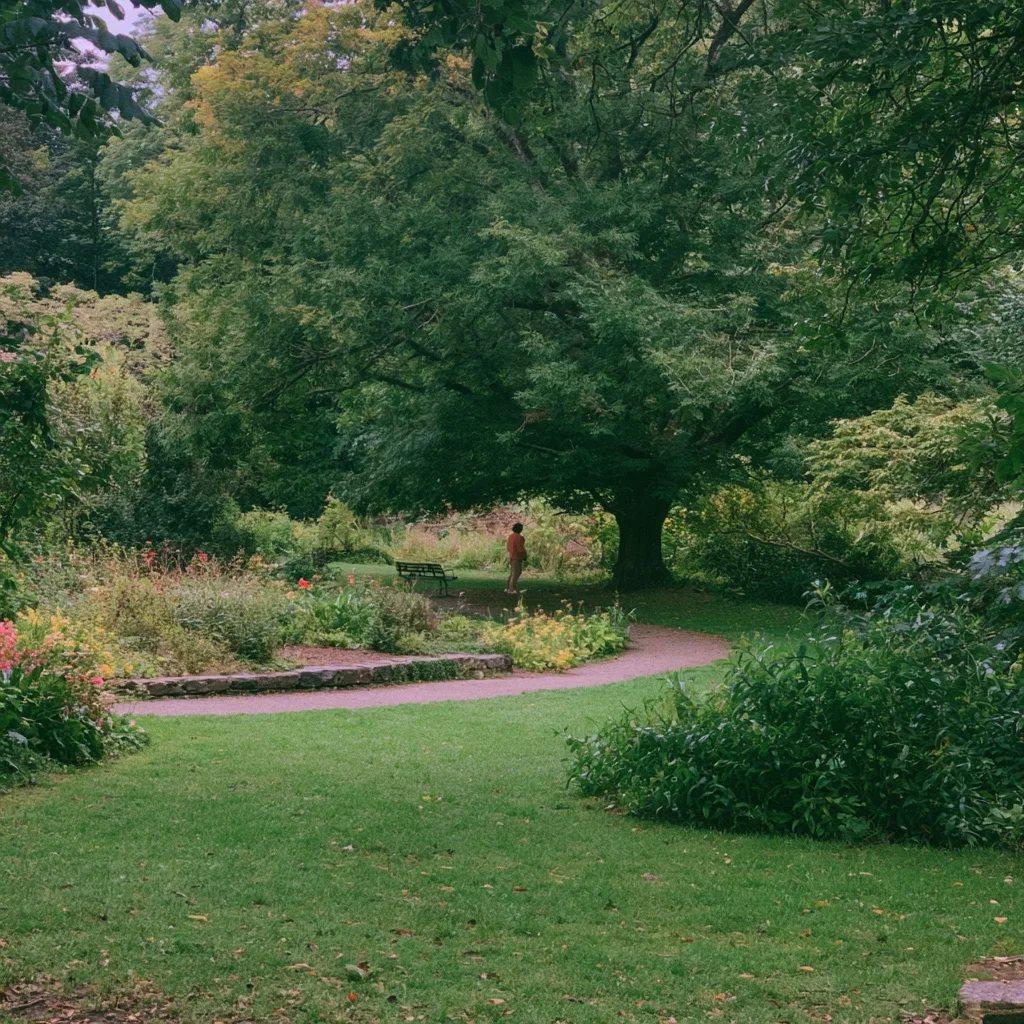
In the park
Find a spot in the park where you can stand or sit for a few minutes, a little away from the main path.
These recordings are short samples, under two minutes each. In the Rewyld app, you can take a guided walk for your place and today’s conditions.
Try a walk in the appRead the words of “In the park”
Find a spot in the park where you can stand or sit for a few minutes, a little away from the main path.
Let your feet, or the bench, take your weight. Breathe out slowly, and let your shoulders soften.
Look up first. What is above you right now? Branches, open sky, the edge of a roof?
Now look at the ground near your feet. What is growing there, or lying there, that you would usually walk past?
Listen. Which sounds belong to the park, and which come from beyond it?
Choose one tree or plant and move slowly towards it, if you can. Notice how it changes as you get closer.
Before you go, look back at where you started. Then carry on at whatever pace feels right.
How to take an awe walk
The study gave people two things to aim for. Awe, the participants were told, “is most likely to occur in places that involve two key features: physical vastness and novelty.” They were asked to tap into their sense of wonder and to go somewhere new each week, if possible. The steps below put that into practice. Fifteen minutes is enough.
- Go somewhere new, or see somewhere old anew. If you can, walk somewhere you have not been before. If not, take a familiar route in the other direction or at a different hour, and look for what you have never noticed there.
- Put your phone away. Keep it in your pocket for the walk, apart from a photo or two.
- Look for something vast. Find the biggest thing in view: the sky, a long view down a street or across water, a tall tree. Stop and take it in for a while.
- Look closely at something small. Then find something small, a leaf, a seed head, a crack in a wall, and look at it as if you had never seen one before.
- Take a photo with the view behind you. If you like, take one picture of yourself with the scene, as the study participants did, and notice how much of the frame is you.
- Walk home slowly. On the way back, notice how you feel. There is nothing particular you are meant to feel.
Things to look for
These are invitations, not a checklist. Take one with you and see what you find.
- The farthest thing you can see. How far away is it, would you guess?
- The sky directly above you. Is anything moving across it?
- The oldest-looking tree on your route. How many winters might it have stood through?
- A flock, a crowd, a river of traffic: many things moving as one.
- Something you have walked past a hundred times. What is on it that you have never looked at?
- After dark, the brightest point of light in the sky, and the faintest one you can still make out.
If you cannot get outside, a window works. Look first at the sky, then at the farthest thing in view. Rewyld’s Being Alive on Earth journey is built on the same sense of scale.
What the study did
Virginia Sturm, Dacher Keltner and colleagues recruited 60 healthy adults aged 60 to 90 through UCSF’s Hillblom Healthy Aging Network. They were randomly put into two groups. Everyone was asked to take a 15-minute walk outdoors once a week for eight weeks. Only the awe group was taught to look for awe, using the instructions quoted above; the control group received no additional instructions, and neither group knew what the other had been told.
On each walk, participants took three photos of themselves: before, during and after. Each afternoon they also answered a short survey about the emotions they had felt that day. The final analysis included 52 people, 24 in the awe group and 28 in the control group.
What changed for the awe walkers
Compared with the control group, the people on awe walks:
- felt more awe during their walks;
- reported more joy and more of what the authors call prosocial positive emotions, such as compassion and admiration, during their walks;
- in daily life, showed a larger rise in those prosocial emotions over the eight weeks, and a larger fall in daily distress, mainly sadness and fear;
- took up a smaller part of the frame in their own photos as the weeks went on, and smiled more intensely in them. Coders who did not know which group a person was in rated the smiles.
That last finding gave the paper its title: big smile, small self.
What the study did not show
This is one small study, and it is often reported as more than it is. Reading the paper itself:
- Scores for anxiety, depression and life satisfaction did not change in either group.
- Daily joy did not differ between the groups, and neither did gratitude.
- The authors describe the effects as modest. The participants were healthy, and most were white and highly educated, which the authors say may limit how far the results apply.
- The analysis covers the eight weeks only. Almost everything was measured by people rating their own feelings; the photos are the exception.
- The control group actually walked more often, about 19 walks each against about 8, without the same gains. The authors read that as a sign the difference came from awe rather than exercise. It is a reasonable reading, not a proof.
So the honest summary is this: in a group of healthy older adults, being asked to look for vastness and novelty on a weekly walk was linked with small, real shifts in how they felt. It costs nothing to find out what it does for you.
Keep going
- A walking meditation scriptFive minutes to read, record or print, with variations.
- The sit spotReturn to one outdoor spot and notice what changes.
- How to take a mindful walkChoosing a route, what to notice, and a short guided walk.
- Walking meditation with RewyldGuided walks composed for your place and the day’s conditions.
Sources
- Sturm, V. E., Datta, S., Roy, A. R. K., Sible, I. J., Kosik, E. L., Veziris, C. R., Chow, T. E., Morris, N. A., Neuhaus, J., Kramer, J. H., Miller, B. L., Holley, S. R., & Keltner, D. (2022). Big smile, small self: Awe walks promote prosocial positive emotions in older adults. Emotion, 22(5), 1044–1058. Published online September 2020. Free full text. DOI 10.1037/emo0000876.
- UCSF Comparative Affective Neuroscience Lab. Awe walk instructions. A public handout from the lab that ran the study.