You don't need to hike 2,197.4 miles
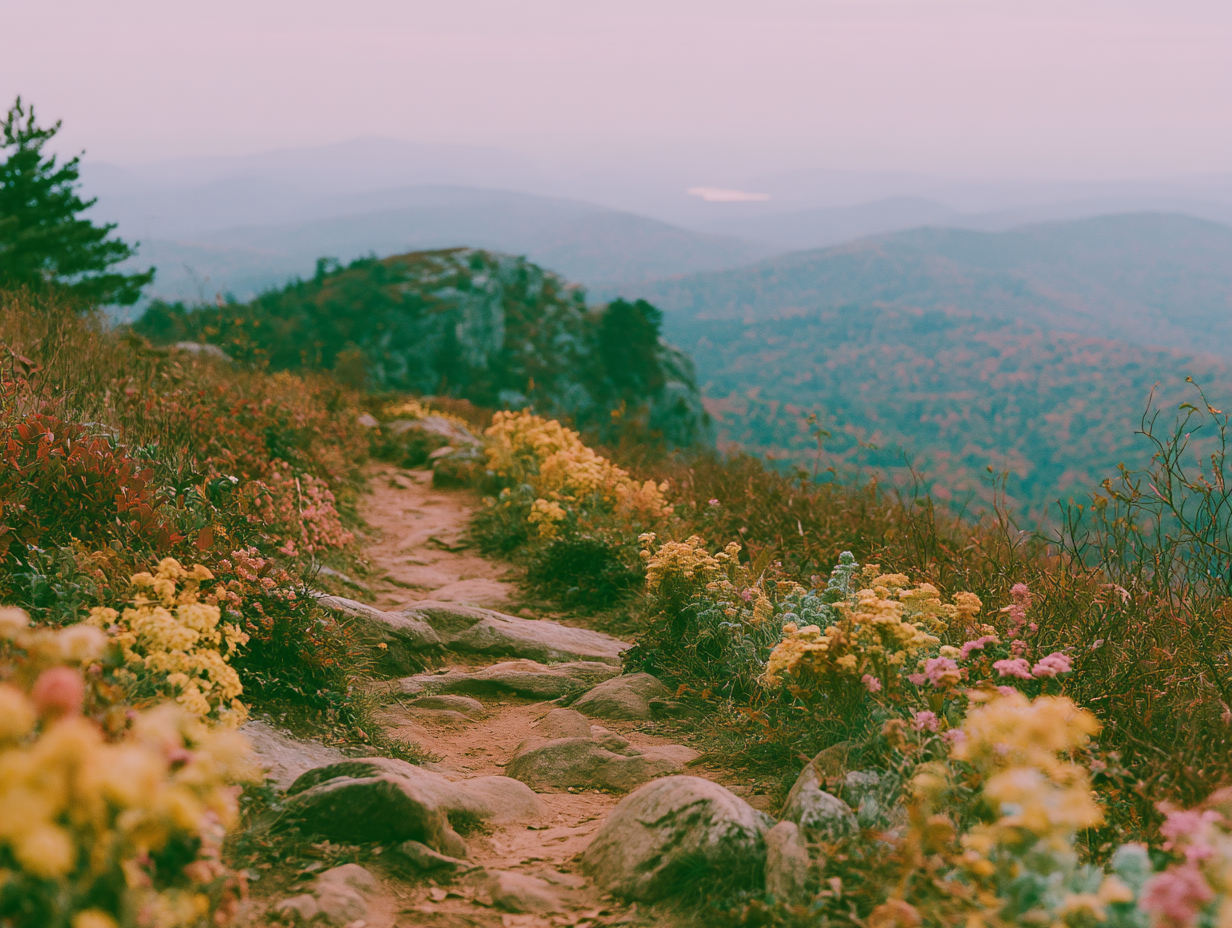
The trail was never really about the trail. Benton MacKaye wrote his proposal for it in 1921 as a deliberate counter to what he called the stampede: the relentless pull of urban pace, noise, and pressure. He was building a prescription for a feeling most people still recognize a century later. The neuroscience has since put fMRI machines to it and confirmed what he was pointing at.
Free mini practice · no account
Try a free guided mindful walk
Pick three, five, or ten minutes. The browser holds the sequence so you can step outside and pay attention to what is around you.
The Appalachian Trail runs 2,197.4 miles, from Springer Mountain in Georgia to Katahdin in Maine. To walk all of it takes roughly five to seven months. About 3,000 people attempt it each year.
Around 16.9 million people visit the trail in the same year. They are not all aspiring thru-hikers. Most of them want to know how long it is. Some walk a mile and turn back. A few take their dogs and eat lunch at an overlook and drive home.
The ratio works out to roughly 5,600 visitors for every one person who commits to the whole thing.
This is not a failure rate. It is a portrait of who actually goes outside.
The person who searches "how long is the Appalachian Trail" at 2 p.m. on a Tuesday is not usually planning a five-month absence from work. She is doing what most of us do when the day gets too loud: imagining a version of escape that feels enormous and unencumbered and green. The trail is a proxy. The feeling it represents is what she is looking for.
Here is what the neuroscience found about that feeling.
In 2015, a team of researchers at Stanford led by Gregory Bratman sent participants on a 90-minute walk. Half went through a natural setting near campus: trees, open space, something that registered as outside. The other half walked along a busy road in Palo Alto. Before and after, the researchers measured rumination, the kind of repetitive, self-focused negative thought most of us recognize as the mental weather of a hard day, and scanned each participant's brain.
The nature walkers came back with measurably lower activity in the subgenual prefrontal cortex, the brain region most strongly associated with that looping thought. They also reported less of it.
The road walkers showed no change.
That second finding is the one that matters. It rules out the explanation that exercise did it, or that getting out of the office did it. The road walkers were exercising. They were out of the office. They had left their desks and moved their bodies for 90 minutes. But the subgenual prefrontal cortex stayed active. It was something specific to walking in a natural setting that quieted it. The study ran in the Proceedings of the National Academy of Sciences.
The thru-hiker walks all 2,197.4 miles of this. The rest of us can do 90 minutes and still be in the same territory. Smaller, but real.
The trail was never really about the trail. Benton MacKaye wrote his proposal for it in 1921 as a deliberate counter to what he called the stampede: the relentless pull of urban pace, noise, and pressure. He was building a prescription for a feeling most people still recognize a century later. The neuroscience has since put fMRI machines to it and confirmed what he was pointing at.
You do not need the 2,197.4 miles. Constant contact with a patch of land works.
Rewyld is built around the minimum version of that: five minutes, outside, attention on something real. The part that matters, without the five months. Try the first practice free.
Have a story to share?
We'd love to hear about your journey with nature and mindfulness.
Share Your StoryA walking meditation app for restless minds.
About five minutes of outdoor mindfulness, anywhere.
Find it on