How to See a Comet That Isn’t There
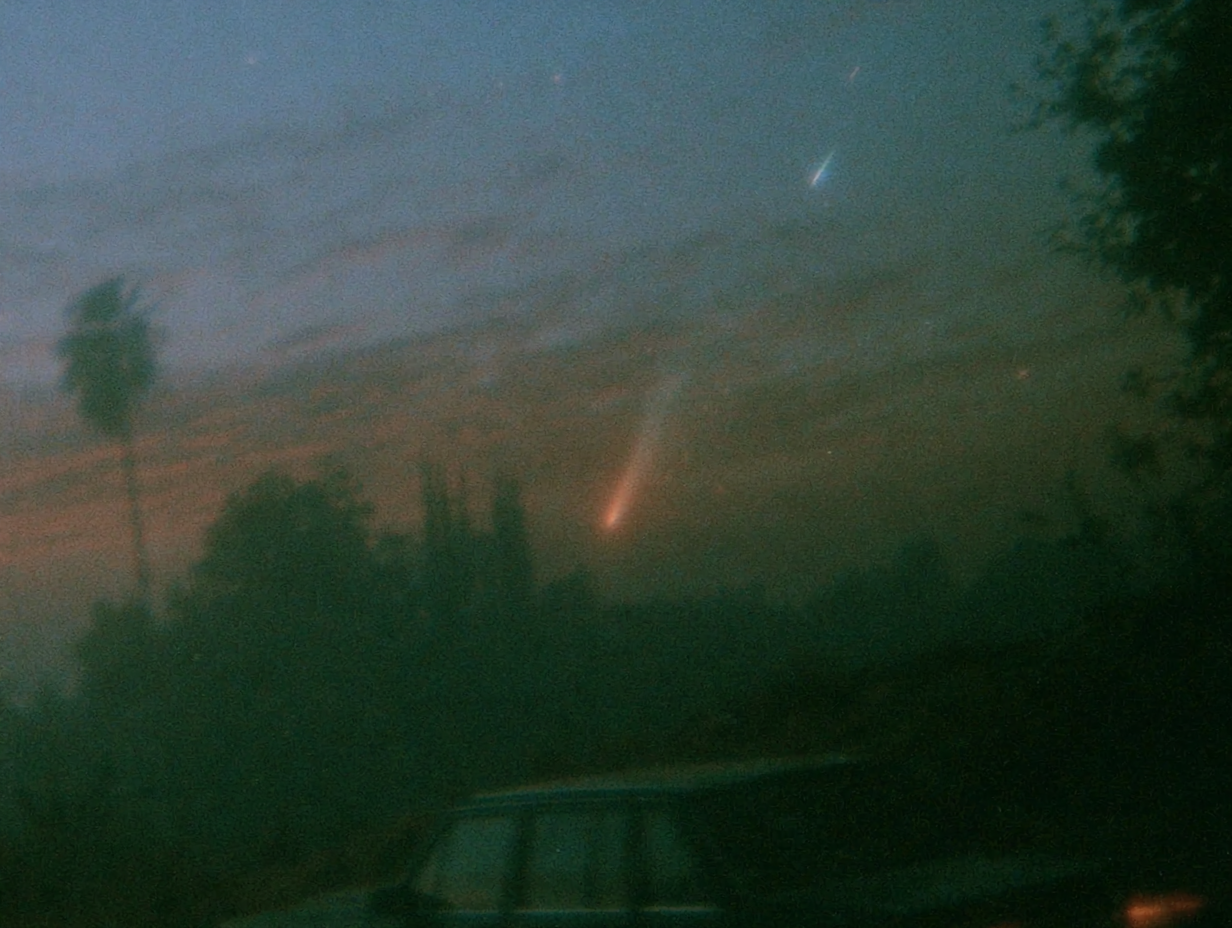
On July 17, Earth entered the debris trail of a comet.
On July 17, Earth entered the debris trail of a comet.
The comet itself, 109P/Swift-Tuttle, will not visit the inner solar system again until approximately 2126. Lewis Swift and Horace Tuttle each discovered it independently in the summer of 1862, looking up from two different American cities within weeks of each other. Swift-Tuttle is large, its nucleus is roughly 26 kilometers across, larger than the object thought to have ended the Cretaceous, and on its orbit around the sun it sheds material: ice, dust, fragments ranging from smaller than a peppercorn to roughly the size of a marble. That material, spread across a band of space the width of a country, crosses Earth's orbital path every year in late July and August.
Earth entered it four days ago.
Each fragment of Swift-Tuttle's debris that reaches our upper atmosphere is moving at 59 kilometers per second. That is more than 130,000 miles per hour. The atmosphere does not let it through. At an altitude of roughly 70 to 100 kilometers, high enough that most aircraft never go near it, the particle encounters air dense enough to matter and burns. The brief streak of light you see from the ground lasts less than a second. The particle that made it, often no larger than a grain of coarse sand, ceases to exist.
The Perseid shower is active now and runs through August 24. The peak, when Earth is deepest in the densest part of the debris band, is August 11 to 13. On a clear night near the peak, with no moon and genuine darkness, you might count around 100 per hour if you know where to look and have given your eyes time to adjust. The radiant point, the region of the sky the meteors appear to originate from, is in Perseus. In the northern hemisphere in July and August, Perseus is above the horizon from around midnight onward and rises higher as the night advances. Most people who try to watch the Perseids do so between 11pm and 2am.
Most of them also have their phones.
To see the faint Perseids, the common ones, not just the occasional bright fireball, your eyes need genuine darkness and enough time in it. The photoreceptors that work in low light are rods, roughly 120 million of them distributed across the retina in a ring around the fovea. Rods depend on a photopigment called rhodopsin, which bleaches in bright light and slowly regenerates in the dark. The regeneration is not instant. The process takes 20 to 30 minutes for the eyes to reach full dark adaptation; partial adaptation happens within the first 10 minutes, but the deep sensitivity, the ability to detect a faint streak from a millimeter-scale piece of comet debris at 100 kilometers altitude, requires the full interval. Physiologist W.A.H. Rushton measured rhodopsin density in the human eye in 1961 and established the kinetics that are still the reference standard in visual science.
A bright phone screen resets much of what those 20 minutes built. The bleaching is photochemical and does not wait. One minute looking at a screen in darkness is enough to require starting the adaptation over. The experience most people have, going outside, looking up, finding the sky too faint to show much, checking the time on their phone, looking back up and still finding it too faint, is a description of a biological process running in reverse.
You cannot simultaneously dark-adapt your eyes and illuminate your face. The constraint is not a matter of attention or intention. It is how rhodopsin works.
The debris trail of Swift-Tuttle will cross our path again next July, and the July after that. The comet left the material behind long ago, on some earlier orbit. Earth is just walking through it. On a clear night between now and August 24, with the moon low or absent, and 20 uninterrupted minutes outside, the eyes built for exactly this kind of darkness can find what is still coming in from a comet that will not return for a century.
The comet will not return for roughly a century. Its debris is here now. Go out after midnight. Put the phone away. Give your eyes twenty minutes. Then look up.
PS: Rewyld is a practice that begins outside, in the dark if that is where the outside takes you.
Have a story to share?
We'd love to hear about your journey with nature and mindfulness.
Share Your StoryA walking meditation app for restless minds.
About five minutes of outdoor mindfulness, anywhere.
Find it on