How to ground yourself
There is more than one way back to yourself. They don't look alike. But I've come to think they are all the same move.
Free mini practice · no account
Try a free guided mindful walk
Pick three, five, or ten minutes. The browser holds the sequence so you can step outside and pay attention to what is around you.
I used to think grounding was something you did to yourself. A technique. A thing you performed, alone, in your own head, to make the head quieter. And when it didn't work, which was often, I assumed I was bad at it.
It took me a while to notice that the times I actually felt steady had nothing in common with that. They weren't me doing something to me. They were me getting pulled out of myself by something real. A task. A texture. A path. Something outside my own thinking reached in and took over, and the noise just stopped on its own.
So I stopped trying to find the one right way, and I started collecting the ways. Here are a few of them. They don't look alike. But I've come to think they're all the same move.
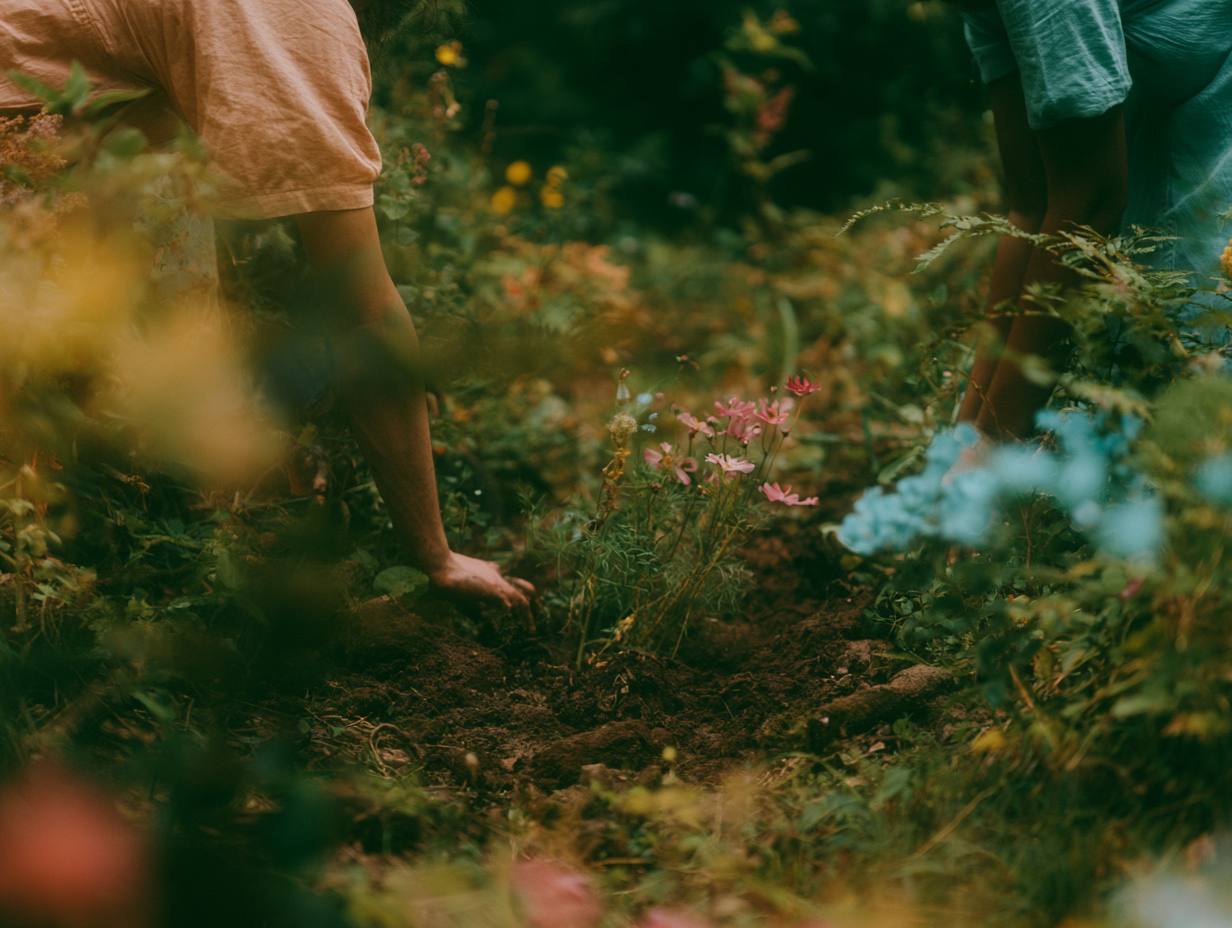
Putting your hands in the soil
There's a community garden a few minutes from where I live, and on a bad week I'll go pull weeds in someone else's bed if they'll let me. Soil is honest. It doesn't care how your day went. It gives your hands a real problem, the kind with no clever solution, only the slow one. You find the root, you follow it, you ease it out. Your attention narrows to the few inches in front of you because that's where the work is, and there's nowhere else for it to go.
Nobody grounds themselves by gardening. The garden does it. You just show up and let it have your hands.
Making something
I'm not good at drawing. That turns out to be the point. When I try to draw a leaf, my eye has to slow down and actually look at the leaf, because my hand can't fake what I haven't seen. There's this half-second lag where the eye leads and the hand follows, and in that gap there's no room for the rest of it. The unsent email. The thing I said wrong yesterday.
It doesn't have to be drawing. It can be anything that asks your hands to keep up with your eyes, or your eyes to keep up with your hands. The making isn't the goal. The looking is. The thing you end up with is just proof that for a little while you were paying close attention to something that wasn't you.
Going for a walk
The thing I love about a walk is that it decides things for you. The path turns, so you turn. There's a hill, so your legs change. A walk takes the part of you that's been running the meeting in your head all day and gives it a job that's already half-done by the ground. Your feet know what to do. You can just come along.
I do this one most. I'll leave with a knot in my chest and come back without it, and I usually can't tell you the moment it left. That's the tell. The good ones don't have a moment. You just arrive home lighter and realize the thing you were chewing on let go somewhere around the second block.
Counting down through your senses
There's an old practice some people know as 54321. You find five things you can see, four you can touch, three you can hear, two you can smell, one you can taste. It sounds mechanical written out like that. It isn't, when you do it. It's a doorway you can use anywhere, with nothing, in a waiting room or a parked car, when there's no garden and no paper and no path.
What it does is narrow you, on purpose, one sense at a time, until the only thing left in your head is what's actually in the room. It's the most portable of these, and the one I reach for when I have no props and no minutes. One of several doors, not the whole house. More on this here https://www.rewyld.earth/grounding
The thing they have in common
Different as they look, every one of these is the same move. You stop performing and you start receiving.
That's it. That's the whole thing I was missing for years. Grounding isn't a thing you generate from the inside. It's contact. It's the moment your attention stops chasing the next thought and lets something real reach you instead. The soil hands your fingers a problem. The drawing pulls your eye a half-second behind your hand. The path decides your steps. The senses narrow you down to right here. Four different doors, and they all open onto the same room.
And the room is calm not because you forced it to be, but because for a minute you weren't the loudest thing in it. The light on the back of your hand got there from the sun about eight minutes ago and you had nothing to do with it. The air you're breathing has been in and out of other lungs than yours. None of it needs you to manage it. You can put the managing down. That's the relief.
Where Rewyld fits
This is the whole reason Rewyld exists, to walk you through the door on the days you can't find the handle yourself.
There's more than one door. Use whichever one is closest. They all let you in.
Have a story to share?
We'd love to hear about your journey with nature and mindfulness.
Share Your StoryA walking meditation app for restless minds.
About five minutes of outdoor mindfulness, anywhere.
Find it on